
Home › Coverages › Workers' Comp Insurance for HVAC Contractors
Workers' comp for HVAC technicians
Workers' compensation for HVAC contractors pays an injured employee's medical care and part of their lost wages after a fall, a burn or a strained back at work. Most states make it mandatory once you put people on payroll. Your rate starts with the HVAC workers' comp class code, 5537 in most states, and the payroll you report under it.
- Since 2003
- 12+ A-rated carriers
- 28 states
- Independent agents
Start your HVAC insurance quote
Takes about two minutes. A licensed agent follows up.
Licensed in 28 states · NPN 7642818 · Since 2003
What workers' compensation for HVAC contractors pays for
Workers' comp is the policy that answers when one of your own people gets hurt doing the work. It has two halves. The first pays the benefits set by your state's statute: treatment for the injury and partial wage replacement. The second, employer's liability, steps in if an injury case lands in court outside the comp system, for example when the tech's spouse files a claim of their own.
HVAC work gives that policy plenty to do. The Bureau of Labor Statistics ranks HVAC techs among the occupations with the highest injury and illness rates. It lists burns from electrical parts or chemicals, and strains or sprains from handling heavy equipment, among the hazards.
The claims an HVAC shop actually files come from the daily routine:
- falls from extension ladders, attic joists and the roof edge beside a rooftop unit
- carrying condensers, furnaces and water heaters up stairs and into attics
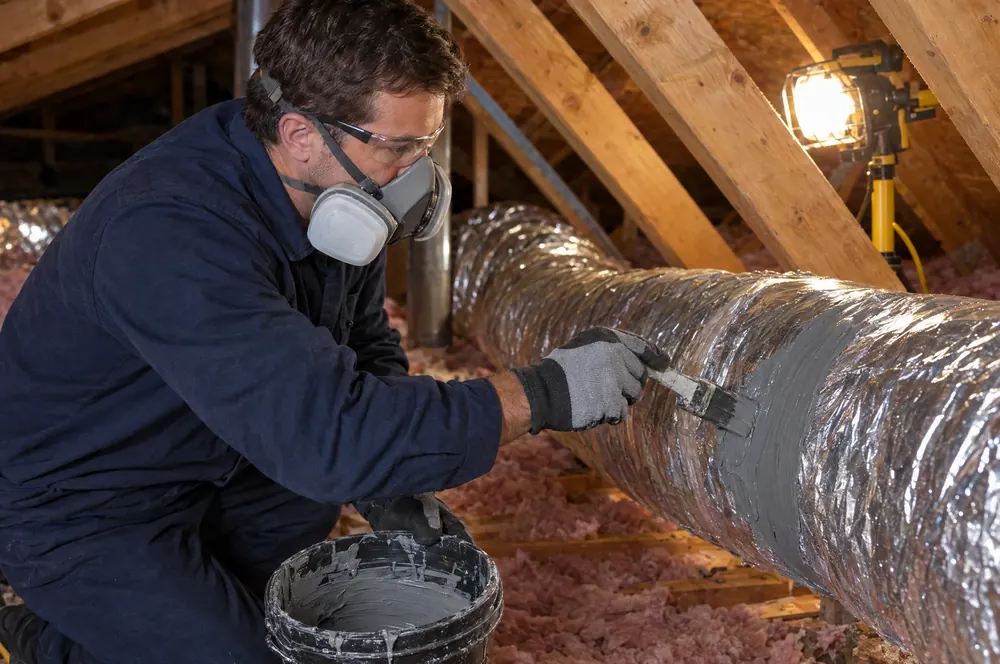
- heat illness during summer attic work and on hot roofs
- shocks and burns from live components in a disconnect or control panel
- frostbite-type burns from liquid refrigerant
- sheet metal cuts and brazing burns
Every one of those claims feeds your class rate and, after a few years, your experience mod.
| Usually paid | Usually not paid |
|---|---|
| Treatment for a tech injured at work, from a roof fall to a refrigerant burn | Injuries to customers, tenants or bystanders (that's general liability) |
| Part of the wages a tech loses while recovering, at rates your state sets | Your own injuries, if you've excluded yourself as an owner or officer |
| Injuries on the road when the trip is part of the job | Damage to the van or the other driver's car (that's commercial auto) |
| Injury suits that land outside the comp system (employer's liability) | Harassment, discrimination or wrongful-firing claims (that's EPLI) |
How HVAC comp claims tend to play out
These examples are fictional. Real claims turn on your state's law, the policy and the facts.
Example scenario: a furnace on the basement stairs
Two installers carry a new furnace down a narrow basement stairway on a change-out. The man on the low end misses a tread, and the cabinet pins his knee against the wall. He needs surgery and six weeks off. Comp typically pays for the surgery and a share of his wages for those weeks, and the claim counts in your loss history the next time your mod is figured.
Example scenario: a hose and a gloveless hand
A tech pulls a charging hose off a liquid line late on a July afternoon without gloves, and a burst of R-410A hits the back of his hand. The frostbite-type burn means an urgent care visit and a few days on light duty. Claims this small add up. NCCI's experience rating gives more weight to how often you have claims than to how large they are.
Example scenario: the box truck on a parts run
A tech running the box truck to the supply house for a replacement compressor is broadsided at a four-way stop and breaks his wrist. Comp usually pays for his injury, because the trip was part of his job. The truck and the other driver's damage go to your commercial auto policy, which typically excludes injury to your own employees.
The HVAC workers' comp class code and the traps around it
Limits and what moves your comp premium
You don't pick a dollar limit for Part One. It pays what your state's law requires. The limit you choose is for Part Two, employer's liability, and contracts often set it for you. One California city's 2026 trade-services agreement, for example, asks for $1 million employer's liability limits next to its auto and general liability terms.
Premium starts as payroll divided by 100, times your class rate. Your experience mod then raises or lowers it. Because the up-front premium rests on estimated payroll, the cooling-season hires you make in May belong in the estimate before the audit finds them.
Where EPLI fits
Comp and general liability won't pay when an employee or job applicant sues over wrongful termination, discrimination, harassment or retaliation. Employment practices liability insurance (EPLI) is built for those claims. It's usually claims-made, and defense costs often come out of the limit. A shop that staffs up for each peak and trims after it has more hiring and firing decisions that could be questioned.
What workers' comp costs an HVAC shop
Published numbers are a starting point, not a quote.
| Source | What it reports |
|---|---|
| One online insurer, its HVAC customers (page dated October 2026) | $119 a month, median |
| One online insurance marketplace, its HVAC customers (updated August 2026) | $127 a month ($1,524 a year), listed as the median for policies bought July to December 2024 |
| Indiana Compensation Rating Bureau, class 5537 advisory rate, effective January 1, 2026 | $1.236 per $100 of payroll |
Run that Indiana rate on $200,000 of tech payroll and the base comes to about $2,472. Your mod, the carrier's own pricing and any minimum premium apply on top. Indiana is one state, and its advisory rate isn't a national number.
What you pay depends on your payroll by class code, your annual revenue, your mix of installation and service work, residential versus commercial jobs, the vans you run, your claims history and the limits you pick.
Which HVAC businesses lean on comp the most
Every shop with W-2 techs has the exposure. The mix shifts with the work.
- Residential replacement shops move heavy equipment through tight stairways and hot attics every week of the season. Our page on residential HVAC insurance covers the rest of their stack.
- Commercial mechanical contractors put crews on roofs and inside GC-run job sites, where the subcontract usually demands a comp certificate and a waiver of subrogation before day one. See commercial HVAC insurance.
- Independent techs with no employees may not need a policy of their own, yet the shops they sub for will still ask for proof of coverage or an exemption. Our page on insurance for HVAC technicians explains the options.
Workers' comp requirements by state
Who must carry comp depends on the state, and a few rules hit HVAC shops early:
- Florida counts HVAC as construction, so comp applies from the first employee, part-time included. The state contractor license also needs proof of comp to issue or renew. Details on our Florida page.
- Michigan requires comp at three employees, or sooner if one worker has put in 35 or more hours a week for at least 13 weeks of the past 52. A full-time helper kept through one heating season can trigger it. See Michigan HVAC insurance.
- North Carolina requires proof of comp before it issues a building permit for work costing $40,000 or more, and a contractor that subs work without getting the sub's comp certificate can owe benefits to the sub's workers. More on the North Carolina page.
Heat rules are changing too. OSHA proposed a federal heat illness standard on August 30, 2024, and as of October 2026 it isn't final. Maryland's rule has applied since September 30, 2024, starting at a heat index of 80°F, indoors and outdoors. Nevada began enforcing its heat rule on April 29, 2025, with a job hazard analysis for employers of more than 10 people. Ask your state OSHA plan what applies to your crews.
Your state's page in our 28-state list covers its threshold and agency.
Related coverage
HVAC workers' comp questions
Does a shop with one W-2 tech need comp?
Is class code 5537 used for HVAC in every state?
Does workers' comp cover a tech hurt while driving the company van?
Will a private insurer write my Ohio comp policy?
Is heat exhaustion in an attic a workers' comp claim?
Ready to see what you'd pay?
Independent agents, 12+ A-rated carriers, and a licensed agent back to you within one business day.