
Home › Coverages › Performance & Payment Bonds for HVAC Contractors
Bid, performance and payment bonds for HVAC contractors
A performance bond guarantees you'll finish a mechanical contract as written, a payment bond makes sure your subs and suppliers collect, and a bid bond holds you to the number you submitted. Public owners require them on larger jobs, and a surety decides how much bonded work your HVAC company can carry by reviewing your financials, experience and credit.
- Since 2003
- 12+ A-rated carriers
- 28 states
- Independent agents
Start your HVAC insurance quote
Takes about two minutes. A licensed agent follows up.
Licensed in 28 states · NPN 7642818 · Since 2003
How performance bonds, payment bonds and bid bonds work for HVAC contractors
Contract bonds are guarantees a surety company makes to a project owner on your behalf. Each one covers a different promise:
- Bid bond. Tells the owner that if you win, you'll actually sign at the number you submitted. The bid bond amount is typically 5% to 20% of the bid price.
- Performance bond. Guarantees you'll complete the work according to the contract.
- Payment bond. Makes sure the people downstream of you collect, like the sheet metal shop that fabricates your duct or the distributor that ships your rooftop units.
If the surety pays on any of them, it expects you to pay it back. That's the core difference from insurance: a bond vouches for your company to the owner, it doesn't take your risk off your books.
When public owners require them
On federal construction contracts over $150,000, the Federal Acquisition Regulation requires both a performance bond and a payment bond, usually each at 100% of the contract price. Federal jobs over $35,000 and up to $150,000 need payment protection instead, chosen by the contracting officer from options such as a payment bond or an irrevocable letter of credit. The underlying statute, the Miller Act, still says $100,000; the FAR applies the higher figure. See the FAR 28.102-1 bond rule.
Most states have their own versions, often called Little Miller Acts, with their own dollar thresholds for state, school and municipal work. Private owners and general contractors can require bonds too, by contract. Get a quote for your HVAC business →
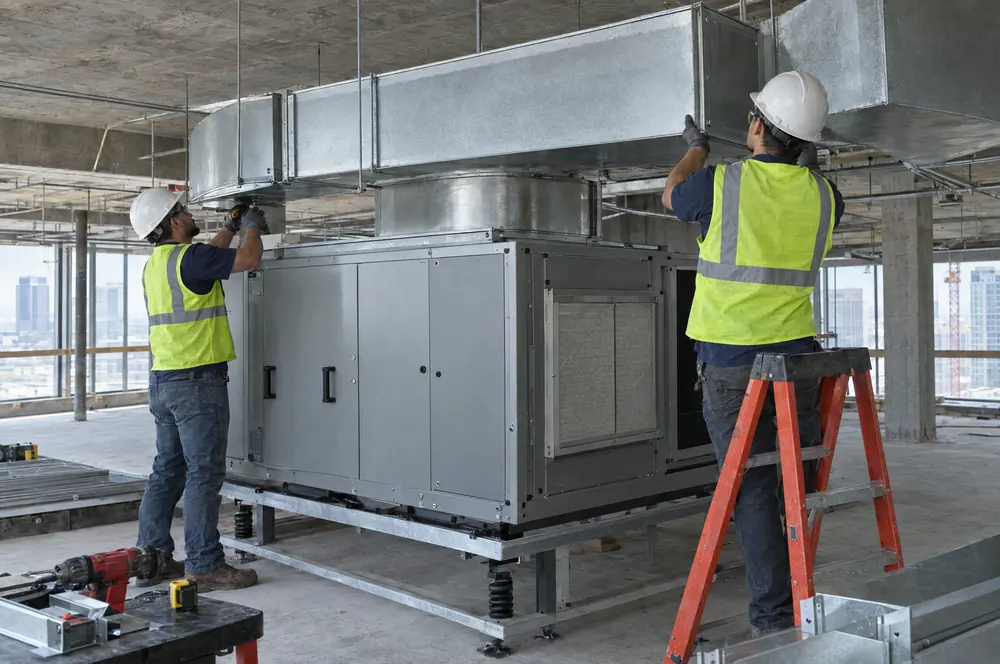
What each contract bond guarantees
| Bond | What it guarantees | Who it protects | What it doesn't do |
|---|---|---|---|
| Bid bond | You'll sign the contract at the price you bid | The owner taking bids | Protect you if your estimate was wrong |
| Performance bond | You'll finish the mechanical scope as the contract requires | The owner, and on some jobs the GC | Pay for your losses on the job |
| Payment bond | Your subs, suppliers and equipment vendors get paid for their work and materials | Those subs and suppliers | Relieve you of the debt; you repay the surety |
How bonds come into play on an HVAC job
These examples are made up to show how each bond works. Real claims depend on the bond form, the contract and the facts.
Example scenario: a low bid with a missing controls package
An HVAC contractor comes in low on a county library's rooftop unit replacement. Two days later, the estimator realizes the number left out the building automation tie-in. If the contractor refuses to sign, the county can claim its loss against the bid bond, capped at the bond's face amount. Whatever the surety pays, the contractor owes back.
Example scenario: cash runs short halfway through a school renovation
A mechanical contractor is replacing air handlers and ductwork across a middle school over summer break. A supplier delay pushes the work into the fall, change orders go unpaid for weeks, and the contractor can't make payroll. When the district declares a default, the performance bond is what it calls on. The surety may arrange for the work to be finished, then seeks repayment from the contractor.
Example scenario: a duct fabricator goes unpaid on a city building
A sheet metal shop fabricates and delivers duct for a city office renovation, but the HVAC prime stops paying its invoices. The fabricator files a claim on the prime's payment bond. The surety reviews the claim, pays what's owed under the bond terms, and turns to the prime for repayment.
What performance and payment bonds cost
NASBP, the national association of surety bond producers, puts the combined price of a performance and payment bond at roughly half a percent to 3% of what the contract is worth. A small or newer contractor with little bonding history should expect the higher end, around 2% to 3%.
| Contract price | At 0.5% | At 2% | At 3% |
|---|---|---|---|
| $250,000 | $1,250 | $5,000 | $7,500 |
| $750,000 | $3,750 | $15,000 | $22,500 |
These are illustrations from NASBP's general range, not quotes. Your rate depends on the contract size, your financial statements, your experience with similar work and the surety itself.
How sureties decide your bonding capacity
Surety underwriters judge three things, often shortened to capital, capacity and character. For an HVAC shop, they'll usually want:
- your last three fiscal year-end financial statements, plus a current interim statement
- a work-in-progress schedule showing every open job, its billings and its expected profit
- your record on jobs of similar size and type
- the size of your bank line, plus the company's and owners' credit
Those answers decide your bonding limit, both per job and across all open bonded work. If you're new to bonding, look at the SBA's Surety Bond Guarantee program. For a qualifying small business it backs bonds on non-federal contracts as large as $9 million, and federal contracts as large as $14 million. That help isn't free. On a guaranteed performance or payment bond, you pay the SBA 0.6% of the contract price, on top of what the surety charges.
Which HVAC contractors need performance bonds
- Commercial mechanical contractors. Public schools, city buildings and many larger private projects ask for bonds as a condition of the bid. See commercial HVAC contractor insurance.
- Residential shops moving into light commercial. A first public rooftop unit replacement or a county building's change-out is often the first time a shop needs a bond. See residential HVAC insurance.
- Refrigeration contractors bidding public facilities. Walk-in coolers and reach-ins in schools and municipal buildings come through the same public bid process. See refrigeration contractor insurance.
- Shops planning their first bonded bid. Start building the financial record a surety wants a year before you need it. Our guide to starting an HVAC business covers the business plan side.
Performance bond requirements by state
Public-work bond thresholds are set state by state, so check the procurement rules for each state and owner you bid. Some states also bring bonds into the contractor license itself:
- Alabama asks new heating, air conditioning and refrigeration contractors to post a $20,000 bond with the state board, which the board's rule calls a performance bond. It's a license requirement, separate from any bond a project owner asks for. See Alabama HVAC contractor insurance.
- South Carolina caps the size of each job by license group, from $35,000 in Group 1 to unlimited in Group 5, and lets a mechanical contractor post a bond in place of a financial statement. See South Carolina HVAC contractor insurance.
- Virginia lets Class A and Class B contractor firms post a $50,000 bond instead of proving the required net worth. See Virginia HVAC contractor insurance.
- Arizona sizes the license bond for commercial specialty contractors by annual volume, so a growing shop's bond grows with it. See Arizona HVAC contractor insurance.
For the bonds tied to licenses and permits, see our page on HVAC contractor license bonds. Rules change, so confirm current requirements with the board or the project owner. Our state pages cover all 28 states where we're licensed.
Related coverage
Performance bond questions
What percentage of the contract is a performance bond for HVAC work?
What's the difference between a bid bond and a performance bond?
Do I need a performance bond for a private commercial job?
How do I increase my bonding capacity?
Can a new HVAC company get bonded?
Ready to see what you'd pay?
Independent agents, 12+ A-rated carriers, and a licensed agent back to you within one business day.