
Home › Coverages › Installation Floater Insurance for HVAC Contractors
Installation floater insurance for HVAC equipment
Installation floater insurance covers the condensers, furnaces, air handlers and other equipment you're putting in for a customer while it rides on your truck, waits in storage or sits on the job. Coverage usually lasts until the owner accepts the work or the system is put to use, a stretch your general liability and tools policies leave open.
- Since 2003
- 12+ A-rated carriers
- 28 states
- Independent agents
Start your HVAC insurance quote
Takes about two minutes. A licensed agent follows up.
Licensed in 28 states · NPN 7642818 · Since 2003
What installation floater insurance does for an HVAC contractor
Installation floater insurance is property coverage for the equipment and materials you've taken charge of for a customer's job: the heat pump, the gas furnace, the evaporator coil, the ductless heads, the line sets, the duct and the thermostat. It's a type of inland marine coverage, written for property on the move.
HVAC equipment rarely goes straight to its pad. It rides on your truck, may sit at your shop or a rented yard for a week, then waits in a garage, a mechanical room or beside a roof curb until your crew sets it. Most floaters apply at each of those stops: in transit, at a temporary storage location, and on the job site before and during installation.
Coverage generally begins when you take responsibility for the equipment, which can be days before anything reaches the site. It typically ends at the first of the events the policy names, such as the owner accepting the work, the property being put to its intended use, or your own financial interest in the equipment ending.
Why your other policies leave this gap
- General liability pays for injury and damage you cause to other people's property. It isn't property insurance for the units you're installing, and it often excludes damage to the particular part of a building you're working on.
- Tools and equipment coverage protects gear you own, like your recovery machine, vacuum pump and digital manifold. A customer's new condenser isn't one of your tools.
- Commercial auto usually covers the truck and what's bolted to it, not the equipment riding in the back.
Installation floater vs. builder's risk
Builder's risk covers a building while it's under construction. The owner or general contractor usually buys it, often at the project's completed value. On new construction or a major renovation, it may also cover materials and equipment meant for the project, sometimes including a subcontractor's.
You still need your own floater when:
- the job is a service or replacement job on an existing building, where there's usually no builder's risk at all
- equipment is in transit or stored off site and the project policy doesn't reach it
- the project policy leaves out subcontractor property, ends before your work is accepted, or carries a deductible your subcontract shifts onto you
Read the subcontract and the project's builder's risk policy before you count on either one. Get a quote for your HVAC business →
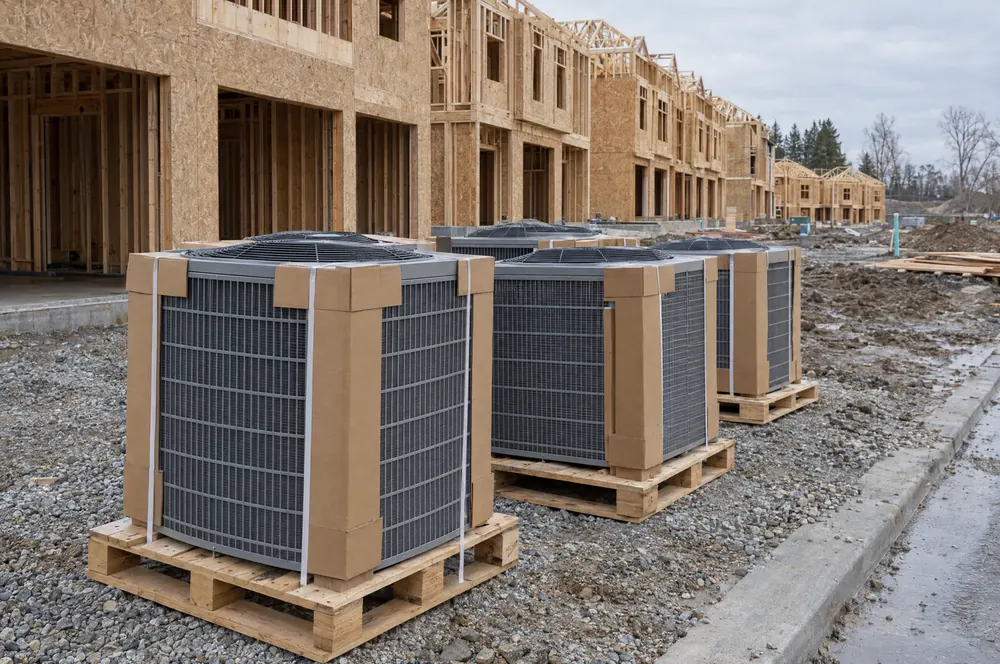
What an HVAC installation floater usually covers
| Usually covered | Usually not covered |
|---|---|
| New condensers, heat pumps, furnaces, air handlers and coils bought for a specific job | Your own tools, gauges, recovery machines and vacuum pumps (a tools floater handles those) |
| Line sets, duct, fittings, controls and thermostats meant for the install | Injury to people, or damage to the rest of a customer's building (general liability territory) |
| Equipment on your truck between the supply house and the job | Equipment after the owner accepts the job or the system goes into regular use |
| Equipment held at your shop, a rented yard or another temporary storage spot named or allowed by the policy | Losses above the per-job, transit or storage limits you chose |
| Theft and physical damage on site before and during installation, subject to the policy's conditions and exclusions | Theft that doesn't meet the policy's security conditions, where the form has them |
How floater claims show up on HVAC jobs
These examples are made up to show how the coverage is meant to work. Whether a real loss is paid depends on the policy wording and the facts.
Example scenario: two heat pumps damaged in transit
A shop picks up two 3-ton heat pumps and matching air handlers for a duplex change-out. On the highway, a car cuts in, the box truck brakes hard and the load shifts. Both outdoor coils fold against the bulkhead. The distributor won't take them back. A floater with transit coverage is the policy built for this, up to its transit limit and after the deductible.
Example scenario: ductless heads stolen from a rented storage unit
Facing long lead times, a contractor orders early for a ten-suite office build-out. Twelve ductless heads, four outdoor units and the line set coils wait in a storage unit the shop rents across town. One night someone cuts the lock and empties it. If the floater extends to temporary off-site storage and the lock met its theft conditions, this is a floater claim. If storage isn't on the policy, it may not be.
Example scenario: an air handler dropped on the basement stairs
Two techs walk a new air handler down a narrow set of basement stairs on a dolly. A strap slips, the unit slides the last six steps, and the cabinet and coil are crushed. General liability usually won't treat the unit as someone else's damaged property, because it's the very thing being installed. An installation floater may pay to replace it.
Limits, theft conditions and price
Floater limits usually come in a few parts:
- Per job or per location. The most the policy pays at one site. Size it to the equipment value on your biggest job, not your average one.
- In transit. The most it pays for property on one vehicle. A truck carrying a full commercial order can hold more value than a whole residential job.
- Annual aggregate. A yearly cap that some forms add on top of the per-job limit.
- Storage. If you stage equipment at your shop or a rented yard, confirm the policy reaches that location and how much it pays there.
Theft rules can matter as much as the limit. Copper has been a target for years: in NICB's count of insurance claims for metal theft from 2014 through 2016, 98 percent involved copper. Ask how your floater handles theft from an open site, and whether it expects fencing, a locked enclosure or a cage over each condenser.
What you pay depends on your payroll by class code, your annual revenue, your mix of installation and service work, residential versus commercial jobs, the vans you run, your claims history and the limits you pick. Our HVAC insurance cost guide lists published ranges for the main policies.
Which HVAC contractors need a floater most
Any shop that buys equipment before sign-off carries the risk in between, especially these four:
- Residential replacement shops. A change-out on an existing home almost never comes with builder's risk, and a matched heat pump system is a large purchase to lose. See residential HVAC contractor insurance.
- Commercial mechanical subcontractors. Even with builder's risk on the project, subcontractor property or off-site storage may sit outside it. See commercial HVAC insurance.
- Refrigeration contractors. Walk-in panels, condensing units and evaporators often arrive in pieces and wait on site before assembly. See refrigeration contractor insurance.
- Independent techs who buy the unit. If you purchase the equipment yourself, a loss before the customer accepts it can land on you. See insurance for HVAC technicians.
Installation floater requirements by state
State licensing boards don't usually tell HVAC contractors to carry a floater. The license rules we've reviewed set liability minimums, comp proof and bonds, and none of those protect equipment you haven't installed yet:
- Florida sets liability floors for air conditioning and mechanical licensees: $100,000 for injuries to the public and $25,000 for damage to others' property. Neither touches your own inventory. See Florida HVAC contractor insurance.
- New Jersey pairs a $500,000 general liability certificate with a $3,000 surety bond for master HVACR contractors. See New Jersey HVAC contractor insurance.
- Colorado has no state HVAC license, but the Pikes Peak Regional Building Department wants a $1 million / $2 million general liability certificate from mechanical contractors. See Colorado HVAC contractor insurance.
- Pennsylvania leaves licensing to cities; Pittsburgh's mechanical trade license asks for the same $1 million / $2 million liability limits plus workers' comp. See Pennsylvania HVAC contractor insurance.
So the push for a floater comes from your contracts, your lender or your own balance sheet. Rules change, so confirm current license requirements with your board or city. Our state pages cover each of the 28 states where we're licensed.
Related coverage
Installation floater questions
What is an installation floater in insurance?
Is an installation floater the same as builder's risk?
Will my installation floater pay if my gauges get stolen?
How long does installation floater coverage last?
How much installation floater coverage do I need?
Does an installation floater cover a condenser stolen from a job site?
Ready to see what you'd pay?
Independent agents, 12+ A-rated carriers, and a licensed agent back to you within one business day.