
Home › HVAC Business Insurance Guides › HVAC Service & Maintenance Agreements
HVAC service agreements: liability clauses and the insurance behind them
If you sell HVAC maintenance agreements, the wording you hand homeowners and property managers sets how much risk you carry on every plan. Clear scope, response terms you can staff, and an attorney-reviewed liability clause keep your promises realistic. Then your liability policies can back up the rest.
Key takeaways
- An HVAC maintenance agreement is a contract you, the contractor, write and sell. Its wording decides how much liability you take on with every plan member.
- The clauses that do the most work: a tight scope with an equipment list, exclusions for old or pre-existing problems, response wording you can staff, refrigerant and parts billed separately, a limitation of liability, and a clear way to cancel.
- "Guaranteed 4-hour response" is a promise, not a perk. Miss it during a cold snap and a customer may argue you owe far more than a refund.
- General liability may respond to injury and property damage tied to your work, including some liability you accept in an indemnity clause. It isn't built to pay for a broken promise by itself.
- Have an attorney review your agreement template. Send the insurance and indemnity sections to your agent before you roll it out.
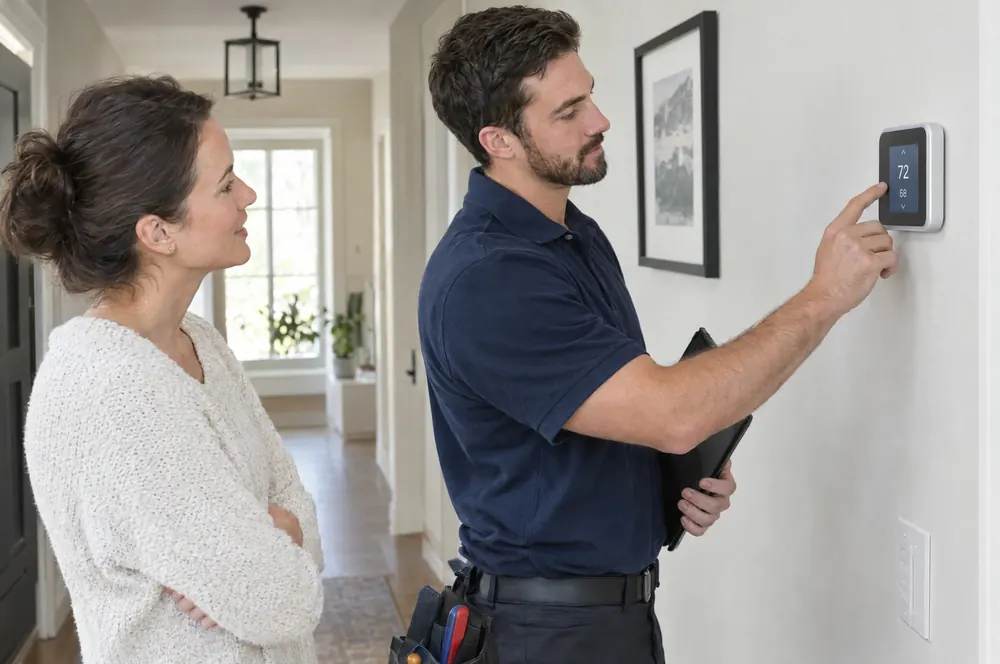
What an HVAC maintenance agreement is, from the contractor's side
This guide is for the shop that sells the plan, not the homeowner who buys it. An HVAC maintenance agreement is a contract where you promise set visits for a yearly or monthly fee. Most plans include a spring cooling tune-up and a fall heating check. Many also add perks like priority scheduling, waived diagnostic fees and a repair discount.
Every line in that contract is something a customer can hold you to later. Picture a fight over a plan that says "we keep your system running." Now picture one that says "two visits a year, tasks listed in Schedule A." The second one is far easier to defend.
Maintenance agreement vs. service contract
People use the two names loosely, but the line between them can matter. State insurance regulators wrote a model law that splits the two. It calls a maintenance agreement a short-term deal for set visits only. A service contract, in that model, promises to fix or replace things when they break. States that adopt the model watch those contracts more closely.
So a top-tier plan that promises "all parts and labor included" may be more than a maintenance agreement in some states. Before you sell repair coverage inside a plan, ask your attorney how your state treats it.
Residential vs. commercial plans
Home plans are sold to consumers. Plain words matter, and consumer rules on auto-renewal and cancellation differ by state. Commercial agreements cover rooftop units, split systems, walk-in coolers and reach-ins for property managers, offices and stores. Those buyers often send their own contract. Its insurance and response terms are written to favor them.
Ten clauses to put in your HVAC service agreement
Here's what each clause does for your shop. Treat this list as topics to raise with your attorney, not as contract language to copy.
1. Scope and an equipment schedule
List each covered unit by make, model, serial number and location: the condenser, the furnace or air handler, the heat pump, every ductless head. Then list the tasks for each visit, such as filter, coil cleaning, condensate line flush, electrical connections and temperature split. A written checklist ends most "you were supposed to check that" arguments.
2. What the plan doesn't cover
Name the exclusions plainly: repairs, parts, refrigerant past a set amount, ductwork, line sets inside walls, mold cleanup and code upgrades. Add damage from power surges, floods, pests or someone else's work. A short "not included" list often protects you more than a long "included" list.
3. Age, condition and problems that came before you
Say that the plan doesn't fix conditions that existed before the first visit. Many shops add a first-visit clause. Say the tech finds a cracked heat exchanger, a leaking evaporator coil or a weak compressor. The customer pays for that repair, or you refund the plan and end it. Record each unit's age on the schedule so nobody argues later about the shape it was in.
4. A tune-up is a check, not a promise
A maintenance visit shows the system's condition on that day. Your agreement can say that a visit doesn't promise the equipment won't fail. It can also say the customer keeps working CO detectors and calls right away about odors, water or a no-heat condition. That wording won't excuse poor work. It does set fair expectations.
5. Response time and priority service
This is the clause most templates get wrong. "Priority scheduling ahead of non-plan customers" is a fair promise. If you name a time, word it as a goal rather than a guarantee, and say what happens in heat waves, storms and cold snaps, when every shop is buried. The next section explains why.
6. Refrigerant and parts pricing
Bill refrigerant by the pound at the rate in effect on the service date, and say so. The U.S. ended new production and import of R-22 in 2020, so systems that still run on it are serviced from existing supply.
The AIM Act also directs the EPA to phase down HFC production and consumption, and R-410A is an HFC blend. A plan that bundles "refrigerant top-offs" into a flat fee can lose money when supply gets tight. Your techs also need EPA 608 certification to handle it.
7. Limitation of liability
This clause caps what you might owe under the contract, often at the fees paid for the plan. It may also rule out indirect losses, like spoiled stock in a walk-in cooler or a store's lost sales during a no-cool day. How far a cap reaches depends on state law, and it may not apply to every kind of claim. That's why this clause needs an attorney who knows your state.
8. Indemnity and hold harmless
An indemnity clause says who pays when someone else sues. Many residential plans don't include one. Commercial contracts usually ask you to indemnify and hold harmless the owner and the property manager. Read whether the clause covers only claims caused by your work, or claims caused by anyone. Many states have anti-indemnity laws. They limit clauses that make a contractor pay for the other side's own carelessness. Most target construction contracts, and they vary from state to state.
9. Customer duties and access
The customer gives safe access to the attic, crawl space or roof, changes filters between visits if the plan says so, and reports problems quickly. Add that your tech can stop work when a space is unsafe, like an attic with no decking or a crawl space with standing water.
10. Term, renewal and cancellation
State the term, whether it renews on its own, how either side cancels, how much notice is needed and how unused visits get refunded. If you auto-renew residential plans, ask your attorney about your state's consumer notice rules.
How your insurance lines up behind the agreement
Your agreement and your policies should be written with each other in mind. Here's how the main coverages usually relate to a service agreement on standard forms. Check your own policy's endorsements and exclusions, because carriers change these terms.
General liability
General liability is built to pay for injury and damage to other people caused by your work. It typically pays to defend you against those claims too. Contractor GL is usually an occurrence form. That means the policy you had on the day of the damage is the one that answers, even when the claim lands years after. See general liability for HVAC contractors for the details.
Completed operations
Completed operations is the part of GL for injury or damage that happens after a visit is over and your van has left. For a maintenance plan, that's where most of the risk sits. Think of a float switch you replaced in spring that fails in July and lets a drain pan overflow into a bedroom ceiling. On standard forms this coverage is built into GL, with its own aggregate limit. Check your declarations page for that number.
Contractual liability and the "insured contract"
Standard GL leaves out liability you take on by contract, with one exception, called an "insured contract." Part of that term covers a deal where you agree to pay for someone else's tort liability. Tort liability is what they would owe by law even with no contract, such as when a tenant trips over your hose in the hallway and sues the owner. When the exception applies, the policy may also pay the owner's defense costs if certain conditions are met.
There are limits. It reaches tort liability, not every promise in the agreement. Some policies cut it back with a contractual liability limitation endorsement, ISO CG 21 39. A state anti-indemnity law may also void part of the clause.
Before you sign a property manager's agreement, send us the insurance and indemnity sections. We'll check them against your policy, and your attorney can explain the legal meaning.
Professional liability
Maintenance plans produce advice: a condition report that gives a heat pump five more years, a replace-or-repair call, a load calc, an energy-savings estimate. If a customer claims a money loss from that advice, GL may not help. GL is built for physical harm. Many contractor GL policies also add an exclusion for design and engineering-type services. Contractors professional liability is written for those claims and is usually claims-made. The policy you carry on the day a claim is filed is the one that answers it.
Higher limits for commercial accounts
Commercial agreements often ask for more than your base policy. They may want higher limits and the owner and manager added to your policy. They may also ask for a waiver of subrogation and wording that makes your policy pay first. An umbrella policy can add limits above your GL, auto and employer's liability. Our guide to certificates of insurance and additional insured requests explains each paperwork ask.
| Clause in your agreement | Coverage that may respond | What it usually won't pay |
|---|---|---|
| Scope and workmanship | General liability and completed operations, for damage your work causes to other property | Redoing your own faulty work |
| Response-time promise | General liability, for physical damage, depending on the facts and wording | Refunds, penalty credits or service-level fines |
| Indemnity and hold harmless | General liability's "insured contract" coverage, unless an endorsement limits it | Promises beyond tort liability, or parts voided by state law |
| Condition reports and recommendations | Contractors professional liability | GL usually isn't built for money losses from advice |
- Start from your real checklist. Write the scope and the "not included" list from what your techs actually do on a spring and fall visit.
- Get one attorney review. Have a business attorney in your state review the template, then again any time you change the liability, indemnity or cancellation terms.
- Send it to your agent. Ask whether your GL carries a contractual liability limitation or a professional services exclusion, and whether your limits fit your commercial accounts.
- Match promises to staffing. Count on-call techs against plan members before you name any response time.
- Train the team on wording. Techs and CSRs should say "priority," not "guaranteed," and keep sales talk inside what the agreement says.
- Keep the paper trail. Store signed agreements, visit checklists, photos and dispatch time stamps in your field-service software. Review the template each year before cooling season.
Plans bring steady revenue, which is often the moment a one-truck shop hires its first W-2 tech. If that's your next step, see what changes on our residential HVAC and commercial HVAC pages. When you want a second set of eyes on coverage, start your quote. A licensed agent goes over your answers and your plan wording before quoting.
Frequently asked questions
What should an HVAC maintenance agreement include?
What's the difference between an HVAC service agreement and a maintenance agreement?
Does general liability cover a breach of my service contract?
Is a free HVAC service agreement template good enough?
Should I promise guaranteed response times on commercial HVAC contracts?
Want a second set of eyes on your coverage?
Independent agents, 12+ A-rated carriers, and a licensed agent back to you within one business day.