
Home › Coverages › Business Owner's Policy for HVAC Contractors
A business owner's policy for HVAC shops
A business owners policy (BOP) rolls three things into one policy: general liability, property insurance for your shop and the furnaces, condensers and copper on its shelves, and business income while a covered fire or storm loss is repaired. Some HVAC shops qualify and some don't, and propane work, payroll and revenue usually decide which side of that line you land on.
- Since 2003
- 12+ A-rated carriers
- 28 states
- Independent agents
Start your HVAC insurance quote
Takes about two minutes. A licensed agent follows up.
Licensed in 28 states · NPN 7642818 · Since 2003
What a business owners policy does for an HVAC shop
A business owners policy, usually called a BOP, bundles three coverages a shop-based HVAC company needs into one policy with one renewal date. It's built for smaller, lower-hazard businesses, which is why it's often priced below the same pieces bought one at a time.
- General liability. Injury and property damage your business causes to other people, including damage that shows up after a job is closed out.
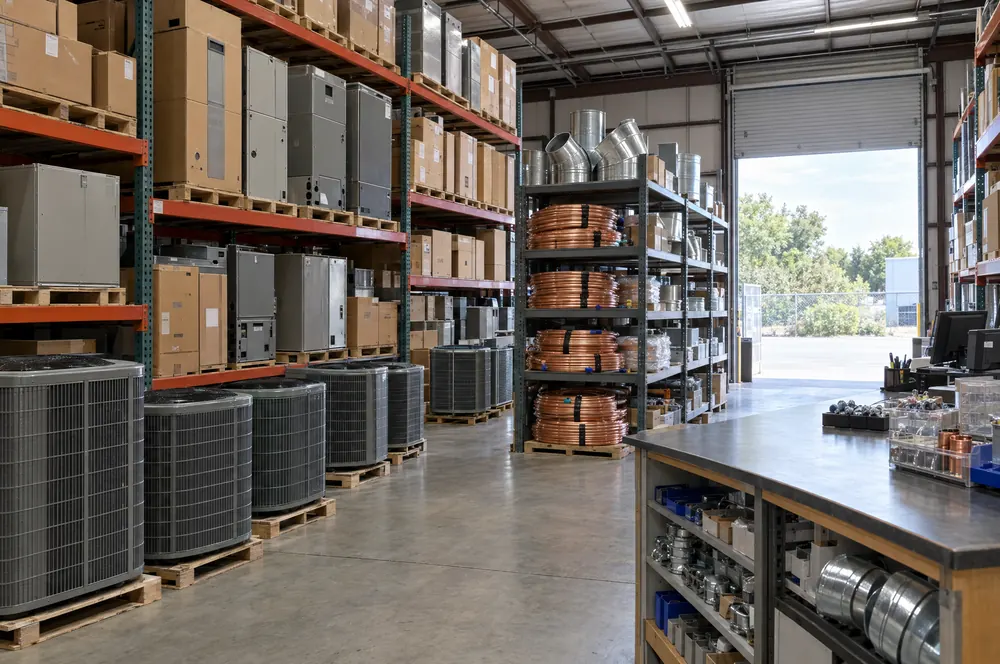
- Property. The shop building if you own it, or the improvements you paid for in a leased space, plus what's inside: equipment staged for installs, coils, filters, parts bins, the copper rack and the dispatch office.
- Business income. Lost income and continuing expenses, which can include payroll, while a covered loss keeps you from operating out of the shop.
Think of a BOP as the policy for the building and the business behind it. The vans, the techs and the gear that rides to every call still need their own coverage.
| What a BOP usually covers | What it usually doesn't |
|---|---|
| Injury or damage your operations cause to others | Injuries to your own techs (that's workers' comp) |
| Your owned shop building, or your improvements in a leased one | Service vans and box trucks (that's commercial auto) |
| Stocked units, line sets, copper, parts and office contents at the shop | Gauges, recovery machines and analyzers out in the field (that's a tools floater) |
| Lost income and continuing expenses after a covered shop loss | New equipment in transit or sitting on a customer's job (that's an installation floater) |
| Equipment breakdown, when the carrier lets you add it | Pollution and asbestos claims, which one published program excludes on every class |
| Liability for a customer hurt at your counter or showroom | Copper, gear or fuel-card theft by your own employee (that's commercial crime) |
How a BOP plays out in an HVAC business
These are made-up examples. Whether any policy pays depends on its wording, its limits and the facts.
Example scenario: a battery charger fire in the parts room
A cordless-tool charger shorts out overnight in late June. By the time the fire department leaves, 11 condensers staged for next week's change-outs are scorched, a pallet of line sets has melted and the dispatch office is full of smoke. The property section of a BOP may pay to repair the space and replace the stock, up to the limits you chose. Business income may help with lost income and ongoing bills while the crews run out of a borrowed bay.
Example scenario: a customer trips at the will-call counter
A homeowner stops by to pay an invoice and pick up a filter. She catches her foot on a strapping band left beside a pallet of furnaces and breaks her wrist. A premises injury like this is the kind of claim the liability section of a BOP is built to answer, including the cost of defending it.
Example scenario: the copper count that keeps coming up short
Month-end counts show three rolls of copper tubing missing, and a fuel card shows weekend fill-ups nobody can explain. A BOP's property section usually won't pay for theft by your own employee. That loss belongs to commercial crime or employee dishonesty coverage, sold on its own or as a small add-on with a low limit. Ask what limit you have before you need it.
Setting limits, and what moves the price
A BOP is only as good as the numbers you put on it. Four of them matter most for an HVAC shop.
- Stock. Set the business personal property limit for your fullest week, not your emptiest. A warehouse staged for cooling season can hold several times what it held in February.
- Building or improvements. If you own the building, insure it for what it would cost to rebuild. If you lease, count the office build-out, the mezzanine and the shelving you paid to install.
- Business income. Ask how long the policy pays after a loss. A shop that takes four months to rebuild in peak season needs more than a few weeks of coverage.
- Liability. A small contractor commonly carries $1 million for each occurrence with a $2 million aggregate. Larger contracts usually reach higher limits through an umbrella.
Equipment breakdown is worth asking about if the shop runs an air compressor, a sheet-metal brake or other powered equipment it depends on.
What you pay depends on your payroll by class code, your annual revenue, your mix of installation and service work, residential versus commercial jobs, the vans you run, your claims history and the limits you pick. On the property side, carriers usually also weigh the building's construction, its fire protection and the stock limit you choose. Published ranges for each coverage are in our HVAC insurance cost guide. Get a quote for your HVAC business →
Which HVAC businesses a BOP fits best
A BOP earns its place when you have a physical shop with real value inside it.
- Residential service and replacement shops with a warehouse, a showroom or a will-call counter are the classic fit. See our page on residential HVAC contractor insurance.
- Commercial refrigeration service companies may qualify too, since that published program lists the refrigeration class. Our refrigeration contractor insurance page covers the food-loss and refrigerant questions a BOP won't answer.
- Commercial mechanical contractors often pass the payroll and revenue caps early. If that's you, the coverages are usually written separately. Our commercial HVAC insurance page explains the contract side.
A one-truck tech with no shop usually gets more from a stand-alone general liability policy and a tools floater than from a package built around property.
State license rules the liability in a BOP can help meet
Several states write a liability floor into the HVAC license itself. The general liability inside a BOP can serve as that proof, as long as its limits and terms match the rule.
- Ohio requires at least $500,000 of contractor's liability insurance that includes completed operations coverage. See HVAC contractor insurance in Ohio.
- Texas sets separate floors for Class A and Class B air conditioning and refrigeration contractors, each with its own completed operations aggregate. See HVAC contractor insurance in Texas.
- New Jersey asks a master HVACR contractor for a $500,000 general liability certificate from an insurer authorized in the state. See HVAC contractor insurance in New Jersey.
A BOP never includes workers' comp, so it can't satisfy a comp rule. California is the sharpest example: a C-20 licensee needs a comp certificate on file even with no employees. See HVAC contractor insurance in California, or browse all 28 states we're licensed in.
Coverage that sits beside a BOP
BOP questions from HVAC owners
Can an HVAC contractor get a business owners policy?
Does a BOP cover my service vans?
What's the difference between a BOP and general liability insurance?
Does a BOP cover theft of copper by an employee?
Is workers' comp part of a BOP?
Ready to see what you'd pay?
Independent agents, 12+ A-rated carriers, and a licensed agent back to you within one business day.