
Home › HVAC Business Insurance Guides › How to Start an HVAC Business
How to start an HVAC business: licenses, insurance and bonds
To start an HVAC business, you set up your license, your company and your insurance in a set order. In many states the policy has to exist before the license does. Get EPA 608 certified and form the company. Then bind general liability and any bond your state needs, and cover the van and first hire before the first install.
Key takeaways
- Starting an HVAC business runs in this order: EPA 608 and the trade license track, the company itself, then insurance and bonds, then the van, the first tech and the first contract.
- Many state boards ask for proof of insurance or a bond before they issue a contractor license, so the policy often comes before the license, not after it.
- State minimums are floors. Texas asks a Class B contractor for $100,000 per occurrence, while many commercial contracts ask for $1 million or more.
- Workers' comp starts with your first employee in most states. A 1099 form doesn't make a tech a subcontractor.
- Write a risk section into your HVAC business plan. Lenders, sureties and general contractors will ask the same questions.
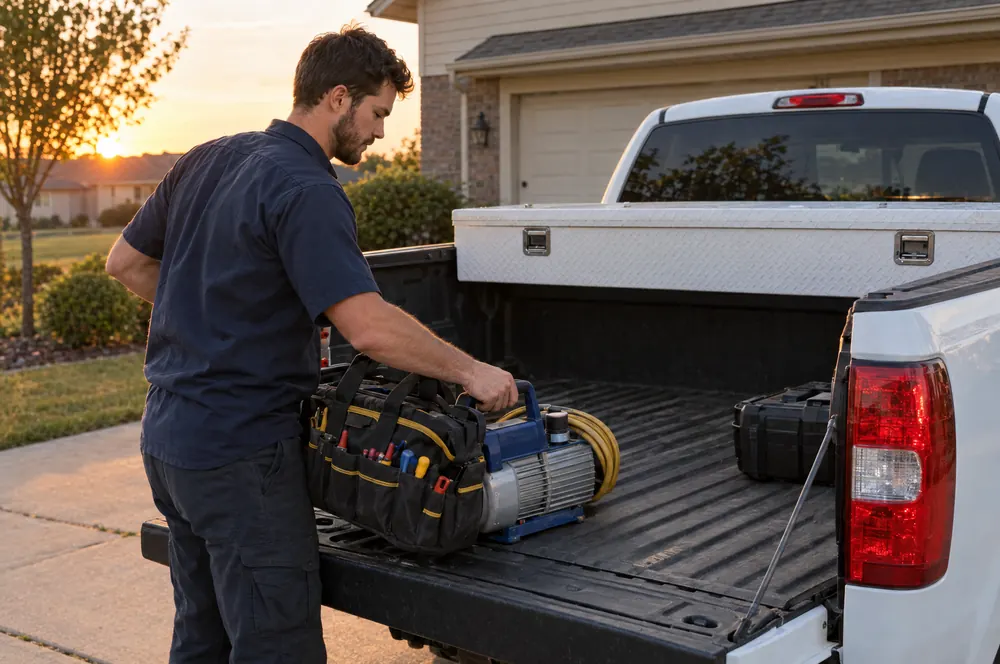
How to start an HVAC business without stalling at the license desk
Most startup checklists put "get insured" near the end, after the logo and the website. That order fails in a lot of states. The board that issues your contractor license often wants a certificate of insurance or a bond in the file first.
So treat insurance as part of licensing, not an afterthought. General liability is the policy that pays for injury or damage your work causes to other people. Bind the right one early, and the license, the permits and the first contract all move faster.
This guide follows the order the paperwork flows. Credentials, company and coverage come first. Then come the growth steps: the first van, the first W-2 tech and the first general contractor (GC) contract.
Starting an HVAC business: the order to do it in
- Get your EPA 608 certification. Federal rules require certification for technicians who maintain, service, repair or dispose of equipment that could release refrigerant. The tests cover Core plus Type I, II and III. See what EPA 608 means for an HVAC business.
- Start the license track for your state or city. Find out which contractor class fits the work you plan to do and what experience the board wants on file. Our HVAC license requirements by state guide sorts the rules.
- Form the company. Pick a structure with your CPA, register it with the state, and get a federal employer identification number (EIN). The IRS issues an EIN at no charge.
- Bind general liability in the company's name. Match the limits to your license class and the contracts you expect to sign. Your agent can then issue the certificate your board asks for.
- Buy any license or permit bond. Some states and cities require one before they issue a license or let you pull a mechanical permit.
- Insure the van and the tools. Put the service van on commercial auto and your gauges, recovery machine and vacuum pump on a tools floater.
- Set up workers' comp before your first hire. Most states require it from the first employee's first day.
- Pull permits and book the first install. Keep copies of your license and insurance papers in the van and at the office.
How HVAC licensing works: three patterns
HVAC licensing is not national. It follows one of three broad patterns, and your pattern decides which insurance documents you need first.
Statewide license with insurance minimums
Some states write a liability floor into the license itself. Texas splits air conditioning and refrigeration contractors into Class A and Class B. Class B is capped at systems of 25 tons of cooling or 1.5 million BTU/hr of heating.
For Class A, the state floor is $300,000 for each occurrence, with a $600,000 general aggregate and a separate $300,000 aggregate for products and completed work. The Class B floor is a third of that: $100,000, $200,000 and $100,000.
In Texas, you file proof of insurance with the state when you apply. Read our Texas HVAC contractor insurance page for that state's details.
Ohio works the same way. Once you pass the exam, the Ohio Construction Industry Licensing Board needs proof of at least $500,000 in contractor liability coverage. Only then does it issue the license. The license and the policy both have to sit with one contracting company. See HVAC contractor insurance in Ohio.
Statewide license with a bond
California licenses HVAC firms under the C-20 class. It covers warm-air heating, ventilating and air-conditioning work.
The state board requires a $25,000 contractor bond before it issues the license. An LLC license also needs at least $1 million of aggregate liability cover if five or fewer people are listed on it.
Local licensing
Other places leave mechanical licensing to cities and counties. In Denver, for example, a contractor license is a two-step process. You first hold a supervisor certificate, or employ someone who does, and then apply for the contractor license. The residential-only heating and ventilating supervisor certificate (Class B) calls for six years of experience: four as a journeyman and two as a designer, draftsman or supervisor. The Class A certificate, which adds commercial work, calls for eight.
Rules change, so confirm the current requirement with your state board or city licensing office before you file. We can't give licensing advice, but we can match your coverage to what the office asks for.
What goes in an HVAC business plan (including the risk section)
An HVAC business plan is a working document, not a school project. A bank, an equipment lender or a surety will read it, and so will you in your second slow shoulder season. Keep it to a few pages:
- Services. Residential service and change-outs, light commercial rooftop units (RTUs), ductless installs, maintenance agreements. Say which ones you'll do in year one and which ones wait.
- Market. The towns you'll cover, the drive times, and who already owns the no-heat calls there.
- Pricing. Your flat-rate or time-and-material method, your service call fee and your maintenance plan price.
- Startup budget. Van, tools, first parts stock, license fees, insurance deposits and three months of cash.
- Financing. What you're putting in and what you need to borrow.
- Risk and insurance. This is the section most templates skip.
A good risk section lists each policy you'll carry, its limits and when it starts. It names the license class you're applying for and the insurance or bond that class requires. It says when you plan to hire, and how you'll handle comp and payroll records. It also lists the records you'll keep on each job, from permits and start-up sheets to refrigerant logs and signed contracts.
Sureties weigh your capital, your capacity and your character when they decide how much bonded work you can carry. A plan that answers those questions up front makes the first bond request easier.
HVAC company startup paperwork: when each piece is due
| Item | When you need it | Who sets the amount |
|---|---|---|
| EPA 608 certification | Before you handle refrigerant | Federal rule |
| Contractor license | Before you bid or pull permits | State board or city |
| General liability | Often before the license is issued | The license class, then your contracts |
| License or permit bond | Before the license or permit, where required | The state or city |
| Commercial auto | The day the van carries tools and goes to jobs | State auto minimums, then your contracts |
| Tools and equipment floater | Before the first tool theft | You (the value of your gear) |
| Workers' comp | Before the first employee's first day | State law |
| Umbrella | When a contract asks for limits above your primary policies | The contract |
A license bond protects the public and the agency that requires it, not you. When the surety pays a valid claim, the indemnity agreement you sign to get bonded lets it come back to you for repayment.
One large online insurance marketplace puts license bond premiums anywhere from 1% to 15% of the face amount. Owners with strong credit tend to land near the low end, around 1% to 3.5%.
What you pay depends on your payroll by class code, your annual revenue, your mix of installation and service work, residential versus commercial jobs, the vans you run, your claims history and the limits you pick.
For ranges by policy, see how much HVAC insurance costs. For the bond side, see HVAC contractor license bonds.
Your first van: commercial auto and a tools floater
Many owners start in their own pickup with magnets on the doors. That works until a claim. A personal auto policy is rated for commuting and errands. Many of them cut back or drop coverage once the vehicle is used for work. Check yours before the first service call.
When the van is in the company's name and runs service calls, it belongs on commercial auto insurance for HVAC contractors.
The auto policy usually covers equipment bolted to the van, like the ladder rack and shelving. Loose gear inside it is a different story. Your recovery machine, micron gauge and vacuum pump usually need their own cover. That's inland marine coverage, often called a tools floater.
See HVAC tools and equipment insurance for how scheduled items and theft-from-vehicle terms work.
If a tech ever drives a personal car to pick up a part, ask about hired and non-owned auto coverage. It covers your company's liability for that trip. It doesn't repair the tech's car.
Your first tech: workers' comp starts on day one
Hiring your first W-2 tech is the point where many states make workers' comp mandatory. The rules differ, so check yours with the state comp agency:
- California requires comp for every employer, even with one employee. C-20 license holders go further: they must keep a comp certificate on file with the state board and can't claim the no-employee exemption.
- Florida requires it for construction employers with one or more employees, part-time included.
- Texas lets most private employers choose. Those that opt out must notify the state and lose some defenses if an employee sues.
- Ohio comp comes only from the state fund, the Bureau of Workers' Compensation. Private carriers can add stop-gap employer's liability.
Carriers rate comp on each $100 of payroll, sorted by job class. Across most NCCI states, HVAC installation and service fall under class 5537. Your carrier assigns the code, and an audit after the policy year settles the final premium.
Read workers' comp for HVAC contractors before you post the job ad.
Your first GC contract: what the paperwork will ask for
The first subcontract from a builder or mechanical GC is where a starter policy often comes up short. The insurance section of that contract usually asks for more than your license did.
Expect requests like these:
- Limits. Plenty of small contractors carry $1 million each occurrence with a $2 million aggregate. Larger jobs may want more, often met with an umbrella.
- Additional insured. The GC asks to be added to your policy so it can lean on it when a claim traces back to your install.
- Waiver of subrogation. Your carrier agrees not to pursue the GC after paying a claim.
- Primary and non-contributory. Your policy pays before the GC's own policy does.
Each of those usually takes an endorsement on your policy, not just wording on a certificate. Our guide to certificates of insurance for HVAC contractors explains each request.
Two other coverages show up on new-construction jobs. Completed operations covers damage that shows up after you finish and leave. It's built into most general liability policies and draws from its own aggregate. An installation floater covers the condensers, air handlers and line sets you're putting in. It protects them while they sit on site, until the job is accepted.
Example scenario: a two-truck shop signs its first subcontract for a 12-unit townhome build. The contract asks for $1 million per occurrence, additional insured status for the GC and a waiver of subrogation. The shop's policy has the limit but no blanket additional insured endorsement. The GC holds the first draw until a corrected certificate arrives. Asking your agent for the contract's insurance page before you sign can avoid that delay.
Read the general liability guide for HVAC contractors to see what a standard policy includes before you sign.
Frequently asked questions
What licenses do you need to start an HVAC business?
What insurance does a new HVAC business need?
How long does it take to start an HVAC business?
How much does it cost to start an HVAC company?
Can I start an HVAC business with my personal truck?
Want a second set of eyes on your coverage?
Independent agents, 12+ A-rated carriers, and a licensed agent back to you within one business day.