
Home › HVAC Business Insurance Guides › EPA 608 Certification
EPA 608 certification and what it means for your HVAC business
EPA 608 certification belongs to each tech, but your business carries the risk when it's missing. Every tech who opens a refrigerant circuit needs the right type, and your supply house needs proof before it sells to you. Underwriters may ask about it before they quote, too.
Key takeaways
- Who needs it: anyone who could release refrigerant while servicing, repairing, installing or scrapping stationary AC or refrigeration equipment. It covers HFCs like R-410A, not just R-22.
- Four types: Type I (small appliances), Type II (high-pressure systems such as splits, heat pumps and rooftop units), Type III (low-pressure chillers) and Universal (all three).
- It's the shop's problem too: a supply house can sell refrigerant only to a certified tech or to a business that employs one and shows proof.
- Fines are real: federal civil penalties now reach $124,426 per day for each violation.
- Insurance angle: our quote form asks if your techs are EPA certified. Underwriters may ask the same thing, so keep a copy of every card on file.
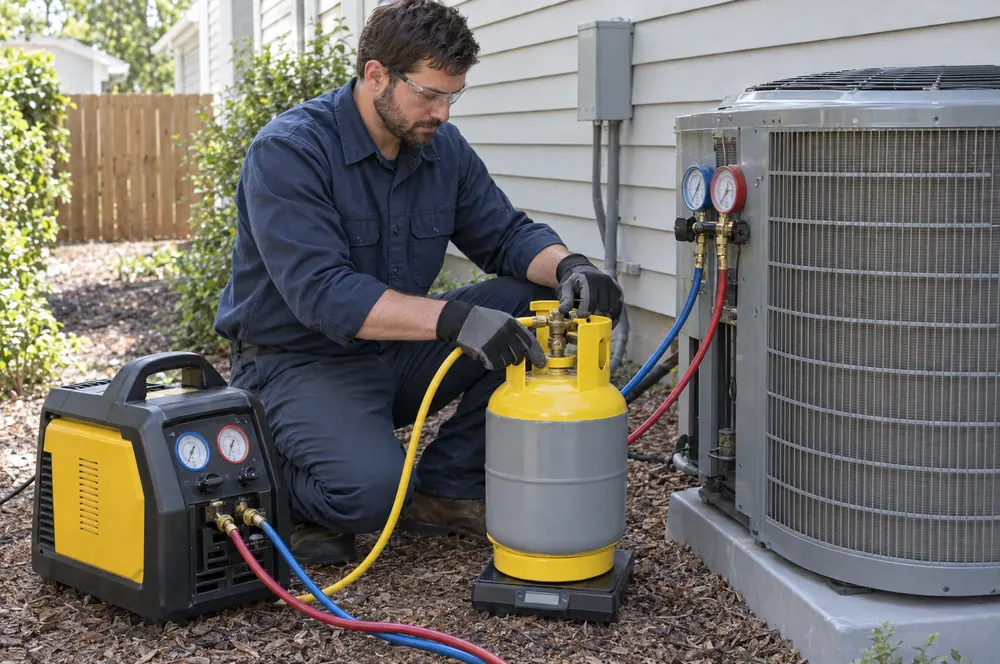
What EPA 608 certification covers, and what it doesn't
EPA 608 certification is a federal credential for people, not companies. It comes from Section 608 of the Clean Air Act, and the EPA's rules for it sit in 40 CFR Part 82, Subpart F.
The trigger is simple. Anyone who could reasonably be expected to open the refrigerant circuit must pass an approved exam. That covers service and repair work, plus scrapping old equipment.
The EPA gives examples in its guidance on mini-split installs. Hooking up or pulling off hoses and gauges counts. So do adding or removing refrigerant, swapping components and cutting a line set.
Since January 1, 2018, the rule has also covered HFCs, not just older refrigerants that harm the ozone layer. That pulled R-410A work into it.
A few things it is not:
- It's not a contractor license. People search for an "HVAC EPA license," but the EPA doesn't license businesses. Your state or city license is a separate step. See HVAC license rules by state.
- It's not run by the EPA. EPA-approved programs give the test and issue the cards. The EPA keeps no national database of certified techs. Since 2018, outside programs have had to post online the names of the techs they've certified since January 1, 2017.
- It doesn't expire, for now. The EPA has kept the right to require recertification later, through a notice in the Federal Register.
- It doesn't cover vehicle AC. Motor vehicle air conditioning falls under Section 609, a different certification.
The four EPA 608 certification types and who on your crew needs which
Each type matches a class of equipment, not a refrigerant. A tech who works outside the type on their card is working uncertified on that job.
| Certification | Equipment it covers | Who on an HVAC crew usually holds it |
|---|---|---|
| Type I | Small appliances: factory-built and sealed, with 5 pounds of refrigerant or less | Techs who mostly work on window units and small self-contained gear |
| Type II | Medium-, high- and very high-pressure equipment, other than small appliances and vehicle AC | Residential and light-commercial techs: split systems, heat pumps, mini-splits, rooftop units, walk-in coolers |
| Type III | Low-pressure equipment | Commercial techs on low-pressure chillers |
| Universal | Everything in Types I, II and III | Techs you want able to run any call on the board |
For most residential replacement shops, Type II is the floor. Many owners push every tech to Universal so dispatch never has to check a card before sending someone to a call.
Two points trip up growing shops:
- Apprentices. An uncertified apprentice may work on equipment only while closely and continually supervised by a tech certified for that type. The apprentice must be registered with the U.S. Department of Labor's Office of Apprenticeship or a recognized state council. Apprentice status lasts two years from that first registration.
- Ride-alongs. Classroom lab work is fine before certification. On-the-job training outside a formal lab course counts as real service work, so it needs a certified tech or a registered apprentice.
If you run solo and are adding your first helper, the coverage page for independent HVAC techs walks through the insurance side of that step.
Why EPA certification is the shop's problem, not just the tech's
The card has the tech's name on it, but the rules reach the business. Under the Clean Air Act, a "person" includes a company, not just a worker. The venting ban starts "No person," so it applies to your company as much as to the tech on the roof.
Refrigerant purchases leave a paper trail
A supply house may sell refrigerant only to a certified tech. The other option is a buyer that employs one and shows proof. The account holder is the buyer. Anyone on your crew can pick up under that account, as long as the account holder can show it is, or employs, a certified tech.
The seller keeps invoices with the buyer's name, the date and the quantity. Where the buyer qualifies through an employee, the seller also keeps the proof of employment. Those records stay on file for three years.
In practice, your supply house file shows how much refrigerant your shop buys, and on whose card. If a tech leaves, update that file. The EPA tells techs to call the supplier if their card is being used by someone who isn't their employer.
Recovered refrigerant isn't inventory
You can't resell refrigerant you pull from a customer's system until an EPA-certified reclaimer has reclaimed it. You can put it back into other equipment that the same customer owns.
Recordkeeping and leak repair basics for owners
Residential paperwork is light. Commercial refrigeration carries more, and a new set of rules started January 1, 2026. Here is what the rules ask for, in plain terms. For the full text, read the EPA's pages or ask a compliance advisor.
- Card copies. Each certified tech must keep a copy of their certificate at your place of business. They keep it until three years after they stop working as a tech.
- Disposal records for 5 to 50 pound systems. When techs scrap mid-sized equipment such as a residential split system, the EPA asks for three things: the location, date and refrigerant type for each unit; the monthly total recovered, by type; and what went out for reclamation or destruction, to whom and when. Keep them three years, on paper or in your field-service software. The EPA lets an employer keep these records for its techs.
- Older systems with 50 pounds or more of ozone-depleting refrigerant. The customer gets an invoice showing how much refrigerant was added. Leak inspections and verification tests carry their own paperwork when the system leaks above the threshold.
- HFC systems with 15 pounds or more, starting January 1, 2026. Under the AIM Act rule, owners must repair leaks above 20% a year for commercial refrigeration, or 10% for comfort cooling and most other equipment. They have 30 days from the refrigerant add, and a certified tech must do the repair. Residential and light-commercial AC and heat pumps are left out of this rule.
- Paperwork to the owner. Under that same rule, a tech who adds or removes refrigerant on a covered system must hand the owner documentation when the job is done.
- Empty disposable cylinders, starting January 1, 2028. Cylinders you're done with must go to a reclaimer, a refrigerant supplier or a final processor that removes the leftover heel.
If your crews service walk-ins, reach-ins and supermarket cases, item 4 is the one to plan for. The refrigeration contractor insurance page explains how food-loss claims after a failed repair tend to play out, and why the policy wording matters.
What's new in 2026: the AIM Act and the switch to A2L refrigerants
The refrigerant change touches every install crew, but it doesn't change the 608 card. The EPA ties certification to the type of equipment, not the refrigerant. It has also said that an "R-410A certification" class is not a stand-in for 608.
The install deadline for R-410A
Since January 1, 2025, new residential and light-commercial AC and heat pump systems can't use a refrigerant with a GWP of 700 or more. GWP stands for global warming potential. VRF systems followed on January 1, 2026. That rules R-410A out of new systems.
The old rule set a January 1, 2026 cutoff for installing leftover R-410A equipment. An EPA final rule published May 26, 2026, and effective July 27, 2026, removed that cutoff. Systems whose specified components were all made in or imported into the U.S. before January 1, 2025 may still be installed.
The same rule set an interim GWP limit of 1,400 for new retail remote condensing units, effective July 27, 2026, and for new supermarket systems starting January 1, 2027. Tighter limits of 150 or 300 start January 1, 2032. If you bid that work, read the rule before you price the job.
R-454B, R-32 and what A2L means for the business
The two main replacements are R-454B, with a GWP of about 470, and R-32, at 675. Both are A2L refrigerants, the lower-flammability class. The EPA lists them as acceptable for this equipment only with use conditions.
We don't give handling or code advice. For A2L training and install rules, look to the maker, your local code office and the EPA. What matters on the insurance side is that your agent knows your install mix changed. New A2L condensers sitting on a job site before start-up are a good reason to check your installation floater limits.
EPA 608 penalties: the current maximums
The EPA adjusts Clean Air Act penalties for inflation. The amounts below are the current ceilings for penalties assessed on or after January 8, 2025. Real fines depend on the facts, and these are the maximums.
| Penalty route | Current maximum |
|---|---|
| Federal civil case in court | $124,426 per day for each violation |
| EPA administrative penalty | $59,114 per day for each violation |
| Cap on one administrative penalty action | $472,901 |
The rule behind most cases is the venting ban. No one working on or scrapping equipment may knowingly vent refrigerant into the air.
The EPA can also ask techs to show their recovery procedures at your place of business. A tech who fails, or breaks the rules, can have their certificate suspended or revoked. A revoked tech has to recertify before touching equipment again, and that pulls a truck off the board.
How uncertified techs affect your liability and underwriting
An uncertified tech doesn't change what your policy says. It changes how a claim gets looked at.
Example scenario: A shop sends a new hire, not yet certified and working alone, to swap a failed valve on a restaurant's walk-in cooler. The repair doesn't hold. The box loses charge overnight and the owner loses a full load of product. The restaurant files a claim, and the first questions are who did the work, whether he was certified and who supervised him. How that claim is handled depends on your policy wording and the facts.
Where general liability stops
A refrigerant leak can lead to cleanup costs or injury claims. Standard general liability has a pollution exclusion. Whether escaped refrigerant fits that exclusion turns on your exact form and on your state's case law. That is the gap contractors pollution liability is built to fill. Check your general liability exclusions, too.
What underwriters may ask
Our quote form asks, "Are your technicians EPA certified for refrigerant handling?" You can answer yes, no, or that some of your techs are. Carriers' applications for HVAC/R work may ask something similar. A "some" answer usually leads to follow-up questions, such as how many techs are apprentices and who supervises them.
Have these ready before you request a quote:
- a list of techs with their certification type
- copies of their cards
- apprentice registration records, if you use apprentices
- your refrigerant supply house accounts
If you're opening your first shop, build the card file on day one. The guide to starting an HVAC business covers the licenses and coverage that come with that first truck.
Verdict on EPA 608 certification for your shop
Treat EPA 608 certification as a shop system, not a line on a résumé. Know which type each tech holds and keep copies of every card. Make sure your supply house account matches your current crew, and file disposal and leak records where you can find them.
Then line your coverage up with the work. A shop with walk-in accounts, A2L installs and new hires gets different carrier questions than a two-truck home service shop. For a sense of how those factors move the price, see what HVAC insurance costs.
Frequently asked questions
How long does EPA 608 certification last?
Can I buy refrigerant without EPA 608 certification?
Do I need EPA certification to install a mini-split?
Is EPA 608 certification the same as an HVAC license?
Can an apprentice work on refrigerant systems without certification?
Do techs need a new EPA certification for R-454B or R-32?
Want a second set of eyes on your coverage?
Independent agents, 12+ A-rated carriers, and a licensed agent back to you within one business day.