
Home › Coverages › Pollution Liability Insurance for HVAC Contractors
Contractors pollution liability for HVAC work
Contractors pollution liability pays for injury, property damage, defense and cleanup costs when your HVAC work causes or worsens a pollution condition, such as a refrigerant release, mold growth or disturbed asbestos. It exists because general liability's pollution, fungi and asbestos exclusions often leave those claims with nowhere to go.
- Since 2003
- 12+ A-rated carriers
- 28 states
- Independent agents
Start your HVAC insurance quote
Takes about two minutes. A licensed agent follows up.
Licensed in 28 states · NPN 7642818 · Since 2003
What contractors pollution liability does for HVAC work
Contractors pollution liability (CPL) is HVAC pollution liability coverage for claims that start with something escaping, growing or being stirred up because of your work. It typically pays for injury and property damage to others, the cost of defending you, and cleanup when your work causes or makes worse a pollution condition.
You need it because a general liability policy shuts several doors HVAC work walks through every week. They aren't all the same exclusion:
- The pollution exclusion. On the standard ISO form, one prong removes pollutants you or your subs bring onto a job site while you're working. Refrigerant in your charging cylinder fits that description. The form has an exception for injury or damage inside a building from gases, fumes or vapors released by materials you brought in, which may help. A total pollution exclusion endorsement, common on contractor policies, removes it.
- The fungi or bacteria exclusion. Mold and bacteria such as Legionella are usually removed by a separate endorsement (ISO CG 21 67), not by the pollution exclusion itself.
- Asbestos exclusions. The base GL form has no asbestos exclusion, but many contractor policies add one. One published small-business program lists it as mandatory for every class.
- Cleanup orders. Costs from a government order or demand to test for or clean up pollutants are excluded on the standard form.
| What CPL usually covers (if the form includes it) | What it usually doesn't |
|---|---|
| Injury to others from a refrigerant release during your work | The lost refrigerant itself |
| Mold damage to a customer's property traced to your work | Replacing the customer's equipment or redoing your own work |
| Bacteria claims, such as Legionella, where the form names them | EPA fines and penalties for your own violations |
| Asbestos fibers released when your crew disturbs old insulation | Exposures the form doesn't list (ask in writing) |
| Cleanup and remediation costs for a covered condition | Your own employees' injuries (that's workers' comp) |
| Defense costs for covered claims | Claims first made after a claims-made policy lapses, without tail coverage |
Where HVAC pollution claims come from
These cases are fiction, written to show the mechanics. Whether any policy pays depends on its wording and the facts.
Example scenario: a charging hose in a basement mechanical room
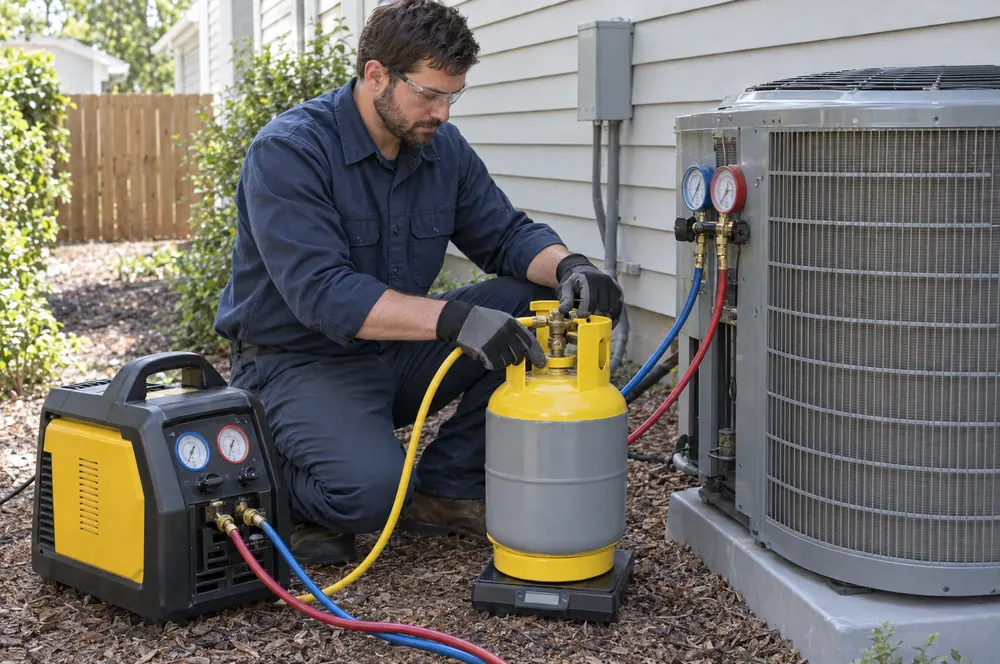
A tech is charging a new split system for a corner bakery. The fitting on his charging hose lets go at the cylinder he carried in, and refrigerant fills a small basement mechanical room. Two bakers who come down to check the noise get dizzy and are taken to urgent care. Their claims point at refrigerant your business brought onto the site. Whether GL helps depends on the building exception and your endorsements; a CPL form that names refrigerant releases is written for this.
Example scenario: sweating ductwork in a crawlspace
A crew installs new supply ducts in a vented crawlspace and leaves gaps in the insulation wrap. The ducts sweat all summer. The next spring, the homeowner finds mold on the joists and subfloor, and the family stays with relatives while a remediation company works. A fungi or bacteria exclusion on your GL would likely take this off the table. A CPL form that covers mold may respond, which is why that word belongs in your written questions.
Example scenario: old pipe insulation in a duplex
A shop replaces a gas boiler in a 1950s duplex. The crew cuts through brittle wrap on the old piping. A test the landlord orders later shows asbestos, both units are vacated, and an abatement contractor cleans the building. The landlord's claim covers cleanup, lost rent and the tenants' hotel bills. If your GL carries an asbestos exclusion, a CPL form that includes asbestos disturbance is the policy that might answer. Get a quote for your HVAC business →
Limits, cost and what CPL won't pay
CPL is sold on its own, and some carriers offer it combined with contractors professional liability. If a commercial contract's insurance exhibit names a pollution limit, size the policy to that number before you bid.
We didn't find a published, dated HVAC-specific price for CPL that we trust, so we won't print a number. What you pay depends on your payroll by class code, your annual revenue, your mix of installation and service work, residential versus commercial jobs, the vans you run, your claims history and the limits you pick. Tell us about any cooling-tower service, older-building work and the refrigerant volumes you handle, since those shape which form fits.
Fines are a separate issue. Under Clean Air Act Section 608, knowingly venting refrigerant while servicing or disposing of equipment is illegal, and recovery has to use certified equipment. Penalties assessed on or after January 8, 2025 can reach up to $124,426 per day per violation in a court action. Fines for your own violations are generally not insurable under GL or CPL. Certification, recovery logs and charging records are your real defense there; see the EPA's Section 608 pages for the rules themselves.
Pollution and refrigerant rules by state
States add their own layers on top of federal rules. A few that shape pollution and CO exposure in states we're licensed in:
- New York requires owners of commercial equipment holding 50 pounds or more of high-GWP refrigerant to keep records, monitor and repair leaks, with registration and labeling phasing in from June 1, 2025. Service contractors become part of that paper trail. See HVAC contractor insurance in New York.
- Colorado requires a CO alarm within 15 feet of the entrance to each sleeping room when a fuel-fired appliance replacement that needs a building permit is done in a single-family home, which puts CO wording front and center on heating work. See HVAC contractor insurance in Colorado.
- Florida requires a CO alarm within 10 feet of each sleeping room in buildings built since July 1, 2008 with a fossil-fuel heater or appliance, fireplace or attached garage. See HVAC contractor insurance in Florida.
For licensing rules everywhere else, start at our state pages.
Related coverage
HVAC pollution liability questions
Is a refrigerant release a pollution claim under my general liability?
Does contractors pollution liability cover mold?
Do residential HVAC companies need pollution insurance?
Will pollution insurance pay an EPA fine for venting refrigerant?
Is CPL written as occurrence or claims-made?
Ready to see what you'd pay?
Independent agents, 12+ A-rated carriers, and a licensed agent back to you within one business day.