
Home › Coverages › Insurance for Independent HVAC Technicians
Insurance for independent HVAC technicians
HVAC technician insurance for a 1099 tech or a one-truck operator starts with your own general liability, coverage for your tools and auto coverage that fits how you drive for work. Before you start, the shops and contractors you sub for will usually want a certificate showing those policies, plus proof of workers' comp or an exemption.
- Since 2003
- 12+ A-rated carriers
- 28 states
- Independent agents
Start your HVAC insurance quote
Takes about two minutes. A licensed agent follows up.
Licensed in 28 states · NPN 7642818 · Since 2003
Where HVAC technician insurance gets tested
Working on a 1099 changes who answers for your mistakes. The shop that hands you the work order buys insurance for its own business. When you're an independent contractor, a claim over your work can land on you first, and the shop will expect your policy to respond.
Here's how solo HVAC work usually goes wrong:
- The problem that shows up later. A ductless head you hung in a living room pulls loose from its wall bracket two weeks after start-up and lands on the customer's piano. That's damage after your work is finished, which general liability typically handles through its completed operations coverage.
- The ceiling you stepped through. Carrying an evaporator coil across attic joists, you put a foot through the drywall of a finished garage.
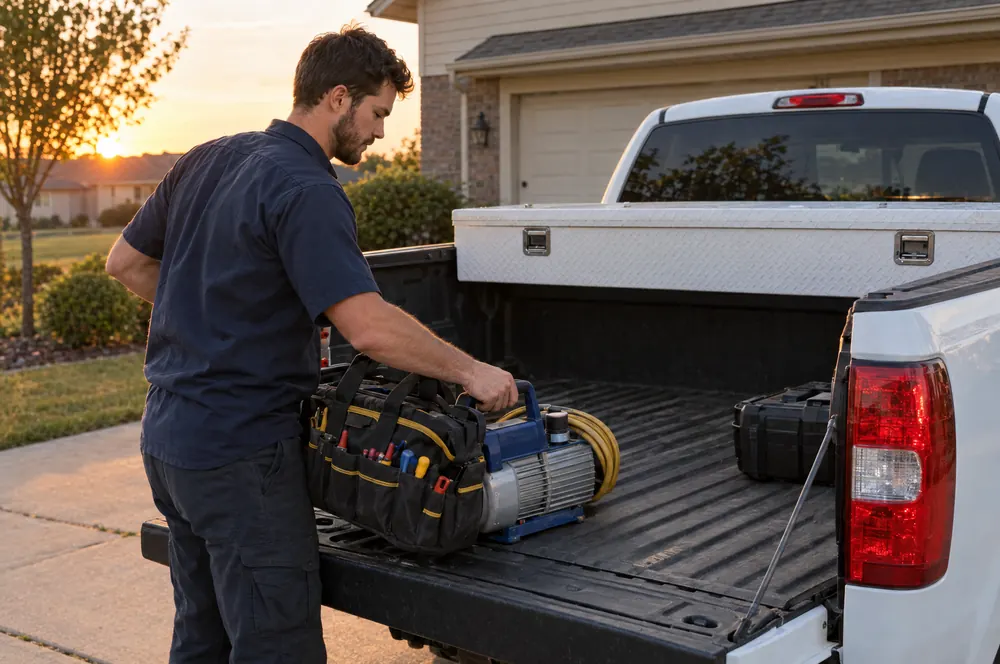
- The gear that disappears. Your recovery machine walks off the tailgate of your pickup while you're inside the supply house.
- The certificate that doesn't match. A shop's GC rejects your certificate because it doesn't show them as additional insured, and you sit out the job until it's fixed.
- The injury with no backstop. You fall off a stepladder in a crawlspace entry, and with no comp or accident coverage of your own, your income stops while your bills don't.
Each of those has a policy built for it. The trick is buying them in the order your work actually needs. A tech who mostly works inside other shops' jobs needs a certificate that satisfies them. A tech who's starting to take direct calls from homeowners needs coverage that stands on its own, because there's no bigger company behind the job anymore.
The coverage stack for an independent HVAC tech
Start with the first three. Add the rest as your contracts and your state call for them.
General liability (must-have)
Covers injury and property damage you cause to others, including damage that shows up after you've left the job. General liability for HVAC contractors
Tools and equipment (must-have)
Your manifold, micron gauge, vacuum pump and recovery machine are how you earn. A floater pays to replace them after theft or damage. HVAC tools and equipment insurance
Commercial auto or HNOA (usually needed)
Many personal auto policies limit or exclude business use. A truck titled to your business belongs on commercial auto; a personal vehicle used for work may call for hired and non-owned coverage at the business level. Commercial auto for HVAC
Workers' comp or an exemption (depends on your state)
With no employees, you may not have to carry it, but the people who hire you may still ask for a policy or proof you're exempt. Once you hire a helper, the rules change. Workers' comp for HVAC
License bonds (if your state or city requires one)
Some states and cities require a bond before they'll license you or issue permits in your own name. HVAC license bonds
Your 1099 status can be challenged
Accident coverage for yourself, and what shops will still ask for
Your tech credentials may not let you contract on your own
What shops and GCs will ask an HVAC subcontractor for
Expect the request before the first work order. A typical subcontract asks for:
- a certificate of insurance showing your general liability limits, commonly a $1 million per-occurrence limit with a $2 million aggregate
- the hiring shop, and often the GC and owner, as additional insured for ongoing and completed work
- a waiver of subrogation and primary and non-contributory wording
- auto liability, and sometimes an umbrella when the job calls for higher limits
- a comp certificate, or proof that you're exempt
- a copy of your EPA 608 certification if you'll open refrigerant circuits
A certificate only reports what your policy says. Additional insured status, waivers and primary wording come from endorsements on the policy, so ask for them when you buy, not the morning the GC calls. Our guide to certificates of insurance for HVAC contractors walks through each box.
Keep your 608 paperwork handy, too. Federal rules require certified techs to keep a copy of their certificate at their place of business, and refrigerant sellers generally may sell only to certified techs or to businesses that employ one and show proof.
Growing from 1099 tech to HVAC contractor
Most independent techs grow in a predictable order, and each step changes the insurance.
- Your first direct customers. Homeowners start calling you instead of the shop. Your general liability now carries the whole job, completed operations included, so make sure it lists the work you actually do.
- Your contractor license. Some states write insurance minimums into the license. In Texas, a Class B ACR contractor must keep general liability of at least $100,000 per occurrence, $200,000 aggregate and $100,000 for completed operations, and a Class A contractor at least three times those amounts. Texas licensees must also give any customer who asks their carrier, policy number and agent's contact details.
- A truck in the business's name. Move it to commercial auto and schedule the tools inside on your floater.
- Your first helper. Workers' comp usually comes next, and your payroll estimate starts to matter at audit.
- Maintenance plans and repeat accounts. Steady revenue, and new promises in writing that your insurance has to back.
Our guide on how to start an HVAC business covers the licensing and paperwork side of that move.
Questions from independent HVAC techs
What insurance does a 1099 HVAC technician need?
Does a solo HVAC tech with no helpers have to carry comp?
Can I be added to the hiring shop's insurance instead of buying my own?
Can occupational accident coverage stand in for a comp policy?
How much general liability does an HVAC subcontractor need?
Related pages
Ready to see what you'd pay?
Independent agents, 12+ A-rated carriers, and a licensed agent back to you within one business day.